
Residential Concrete
Concrete Sidewalks and Walkways in Smithville, MO
Concrete sidewalks and walkways handle the foot traffic paths that connect a property — front entries, yard connections, and paths between structures. In Smithville and Northland neighborhoods, aging walkways are a common source of trip hazards and drainage problems. We pour walkways that are graded for drainage away from the foundation, reinforced for KC freeze-thaw cycling, and built on a compacted base that handles Clay County soil movement.
Free Estimate
Request a Free Sidewalks & Walkways Estimate
What You Get
Safe, Finished Paths That Connect the Property
Well-poured walkways eliminate the mud, uneven surfaces, and trip hazards that accumulate on unpaved or aged paths. A front entry walk sets the first impression of the property; side and back walks make daily circulation around the house cleaner and safer.
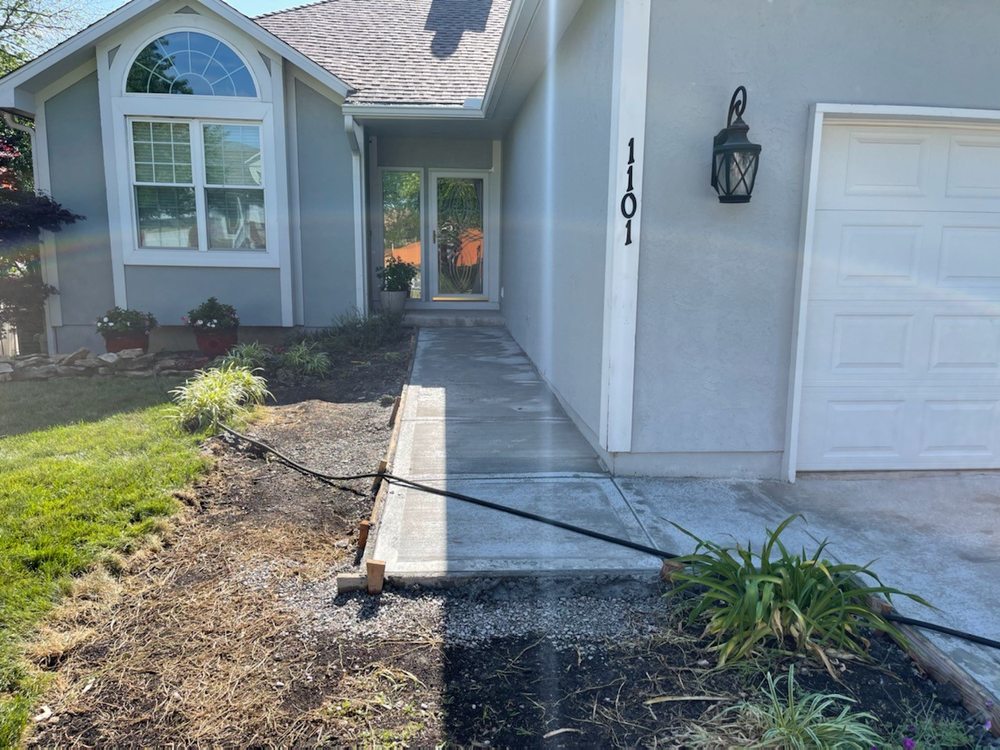
- Front entry walks from the driveway or street to the main entry door
- Side-yard paths providing dry, stable access around the house
- Backyard walkways connecting outdoor living areas, sheds, and gates
- Replacement of heaved, cracked, or uneven existing walkways
- Public sidewalk replacement when required by municipality
- Grading and transitions at driveways, landscaping, and stairs
Common Projects
When Homeowners and Businesses Call Us for Sidewalks & Walkways
Trip hazards from heaved or cracked walks
Walkway sections that have lifted from frost heave or tree root growth create genuine trip hazards — especially at entries and high-traffic paths.
No front walk to the door
A home with no defined entry walk forces visitors to walk on the lawn or driveway. A front walkway is a basic curb appeal and functional improvement.
Muddy or impassable side yard
Side yards that turn into mud during rain seasons make access to the backyard, meters, gates, and structures difficult for part of the year.
Connecting outdoor living features
Linking a driveway to a patio, a patio to a shed, or a pool area to a back entry with a defined concrete path.
Tree root damage
Mature trees in established Northland neighborhoods frequently lift walkway sections. Replacing the affected sections — sometimes with a rerouted path — is the practical solution.
Technical Standards
What Makes a Well-Installed Sidewalks & Walkways
4-inch thickness minimum for residential walks
Standard residential walkways are 4 inches thick. Side-yard paths or areas that see vehicle clearance should be 5-6 inches.
Cross-slope for drainage
Walkways should have a slight cross-slope (1/8 inch per foot minimum) to shed water off the surface rather than letting it pond and penetrate into the base.
Transition treatment at grade changes
Where walkways meet driveways, stairs, or sloped ground, the transition needs to be planned so it does not create a lip, edge trip, or water trap.
Control joints every 4-5 feet
Narrow walkways need more frequent control joints than wide slabs because the slab width limits how it can flex. Joints every 4-5 feet prevent random cracking across the walk.
Broom finish for traction
A light broom finish provides surface traction in wet conditions — important for entry walks and any path that sees regular foot traffic after rain or in winter.
Local Context
Sidewalks & Walkways in Smithville and the North KC Metro
Frost Heave on Walkways
Narrow sidewalk sections on clay soil heave more noticeably than wide slabs because each section moves independently. Proper base depth and compaction reduce heave significantly.
Tree Roots in Established Neighborhoods
Mature trees in Smithville and surrounding Northland neighborhoods frequently produce root systems that lift walkway sections over time. Sometimes re-routing the walk around the root zone is the better long-term answer than repeated replacement.
Clay Soil Drainage at Walk Edges
Poorly drained clay at the edges of walkways erodes the edge support over time. Keeping water moving off and away from the walkway extends its service life.
How It Works
Getting a Sidewalks & Walkways Estimate
Request a Quote
Call or submit the estimate form. We ask a few questions about your project and confirm availability for a site visit.
Site Visit and Written Quote
We assess the site in person — dimensions, soil, drainage, access, scope. You receive a written quote with specs included.
Prep and Pour
We arrive on schedule. Excavation, base work, forms, pour, finish, and control joint work — most residential projects are done in a single visit.
Cure and Walk-Through
We walk the project with you when complete. Cure timeline, deicer guidance, care instructions, and any questions before we leave.
FAQ
Common Questions About Sidewalks & Walkways
How wide should a residential front walkway be?
Can you replace just the sections that are heaved?
Do I need a permit for a residential walkway?
How do you handle a walkway near a large tree?
Related Services
Concrete Driveways
Driveway installation and replacement for daily access, curb appeal, drainage, and long-term use.
Concrete DrivewaysConcrete Patios
Patios and outdoor living concrete for backyards, grilling areas, seating spaces, and cleaner outdoor flow.
Concrete PatiosConcrete Repair & Replacement
Repair, resurfacing, replacement, and practical guidance for cracked, settled, or worn concrete.
Concrete Repair & ReplacementADA Concrete
ADA ramps, accessible entries, walkways, and commercial access concrete.
ADA ConcreteWe provide sidewalks & walkways throughout the north KC metro — Smithville, Kearney, Platte City, Parkville, Kansas City, Liberty, Gladstone. View all service areas
Get a Free Sidewalk or Walkway Estimate
Call or submit a request online and we will follow up within one business day.